

- Published:
- Thursday 3 September 2026 at 2:59 pm
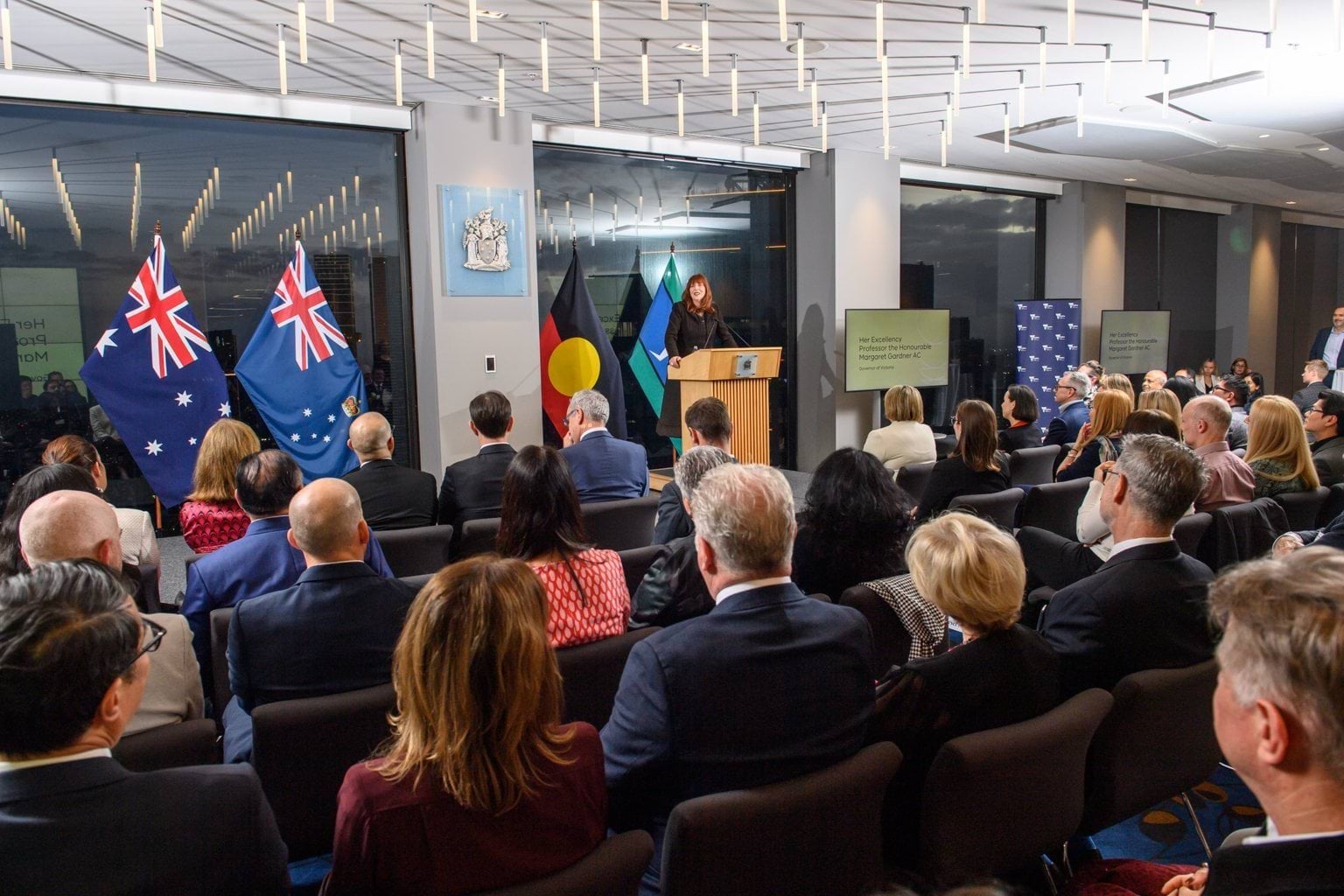
I begin by acknowledging the Traditional Owners of the lands on which we meet, the Wurundjeri people, and pay my respects to their Elders, past and present.
Good evening, and welcome to the 2026 Governor of Victoria Export Awards.
Tonight we celebrate Victorian businesses taking their products, ideas and expertise out into the world, and all the effort it takes to get to that point.
There are businesses developing medical treatments and surgical technology, protecting critical infrastructure and data, cleaning water, producing food as well as wine, delivering education and training overseas, and creating video games enjoyed around the world.
Some exports you can pack into a container.
Others export code, knowledge, creativity, or simply a better way of doing things.
But whatever form the export takes, the decisions behind them are much the same: a business builds something here, believes it can hold its own in the world, and is willing to put that belief to the test.
It is an impulse that comes readily to an outward-looking State like Victoria.
Because that instinct isn't new.
In the nineteenth century, one of the great testing grounds was the international exhibition.
Countries brought together their best inventions, machinery, agricultural products, works of art and manufactured goods, all in one place.
For businesses, these exhibitions were a chance to place their work alongside competitors from around the world and see how it measured up.
Among the best known were the Great Exhibition in London in 1851 and Chicago’s World’s Fair in 1893.
And as many of you know, we had our own International Exhibition in Melbourne in 1886-81 at the Royal Exhibition Building – our first World Heritage listed building.
Perhaps the most famous of them all was held in Paris in 1889, an exhibition that gave the world a vast iron tower, constructed at its entrance.
It was the Eiffel Tower.
Many Parisians disliked it at the time.
The locals, it seems, were not easily impressed by its engineering or design.
But there is a lesser-known Victorian story from that same exhibition.
Among the exhibits sent to Paris was wine from St Hubert's Vineyard, near Lilydale.
Consider, for a moment, the confidence that required.
France was synonymous with fine wine.
Meanwhile, Victoria’s industry was still young and establishing itself.
There were certainly easier places to take Victorian wine than Paris.
But the winemakers at St Hubert’s were prepared to go where the standards were highest and let the quality of their work speak for itself.
Then came the judges' verdict.
St Hubert’s received a Grand Prix.
Today, Australian wine has a world-class reputation.
But that reputation had to be earned, bottle by bottle and market by market, by those prepared to present their work to the most demanding audiences they could find.
It’s a reputation we continue to build.
Last month, while on an official visit to regional Victoria, I met with the owners of a winery near Rutherglen.
Theirs was a vineyard spanning six generations of one family.
And the secret to such longstanding success?
To make good wine, they told me, you need to be ‘a bit obsessive.’
I’m sure many of you can relate to that sentiment.
Because it’s a kind of obsession that leads you to research everything there is to know about an industry…
…to continuously improve your products or services to meet the needs of the market…
…and to make the leap of faith to put them on the global stage.
More than any good or service, it’s this urge for passion, dedication and ambition that we celebrate tonight.
To every finalist, congratulations.
Together, you are taking Victorian products, ideas and expertise to the world, and you should be incredibly proud of how far you have already come.
And to those who will go on to represent Victoria at the Australian Export Awards, I know you will do us proud.
Thank you.
Updated