

- Published:
- Wednesday 19 August 2026 at 9:12 am
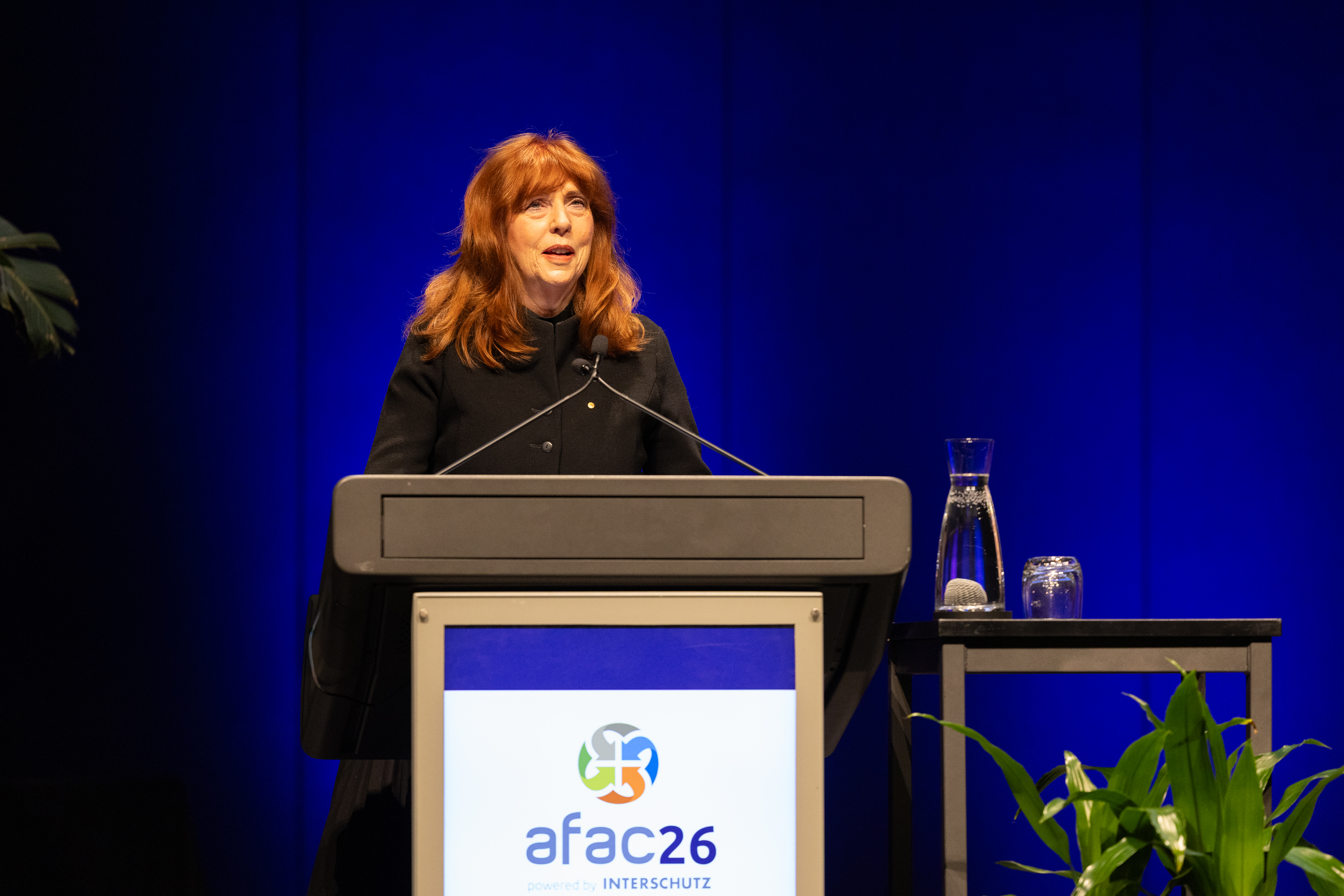
Thank you Uncle Bill Nicholson and Piki Thomas for that warm welcome.
I begin by acknowledging the Traditional Owners of the lands on which we meet, the Wurundjeri people, and pay my respects to their Elders, past and present.
It is a great pleasure to welcome you to Melbourne for AFAC26.
This is a State with deep experience when it comes to managing emergencies and their effects.
Victoria had already faced the catastrophic Black Thursday bushfires of 1851 just as it formally separated from New South Wales.
In this city’s early years, firefighting was carried out by a patchwork of different brigades, many maintained by private insurance companies.
Insured buildings carried a plaque, known as a fire mark, showing which company covered the property.
Each company had its own brigade.
When a fire broke out, several brigades might race to the scene.
They would look for the mark on the building.
If it belonged to their company, they fought the fire.
If not, suddenly the fire became someone else’s problem.
It was not the most sophisticated system of public safety.
And, keeping the vital information on the building, already on fire, suggests more systems were needed.
Thankfully, we have come some distance since then.
Today, when an emergency happens, the first question is not whose problem it is.
The question is what needs to be done.
Then people get on with doing it.
Everyone in this room knows how much work it takes to make that possible.
Emergencies do not respect boundaries.
A fire does not respect property lines
A flood does not care who owns which piece of land.
And a community in danger does not care which organisation is responsible for which disaster.
What matters is whether the right people can work together.
And that’s a capability to build long before an emergency ever starts.
It’s built through training, planning and relationships developed over years.
And that goes to the heart of this year’s theme: Leading Together: Integrity, Inclusion and Impact.
Integrity builds trust.
Trust in warnings, in shared information, and in the people making the hard calls.
Inclusion begins with listening.
Listening to communities that know their risks, who needs extra help, and what messages will land.
And impact is the ultimate test.
Did people know what was required of them?
Could help reach them when it was needed?
How did community recover afterwards?
Those are the questions that matter.
That is also why conferences like this are valuable.
No organisation can know everything.
No State or territory will face every kind of emergency.
And no one should have to learn every lesson for themselves.
I said earlier that this is a State with deep experience when it comes to emergency management.
Today, we also have deep expertise.
Experience may make you familiar with a situation, but expertise gives you the tools to respond more effectively.
And that’s only achieved when people work together to share ideas and knowledge across sectors – just as you are doing here.
That is a long way from rival brigades arriving at the same fire and arguing over whose responsibility it was.
We know this collaboration will be as vital as ever as communities face the threat of natural disasters with increasing frequency.
Over the next few days, this conference will give you the opportunity for those important conversations.
For now, I want to leave you with a simple message of gratitude:
Thank you for the skill, judgement and bravery you bring to this work.
And thank you for your shared commitment to ensuring we don’t just confront emergencies – we learn from them too.
Thank you.
Updated