
- Published:
- Saturday 14 February 2026 at 3:51 pm
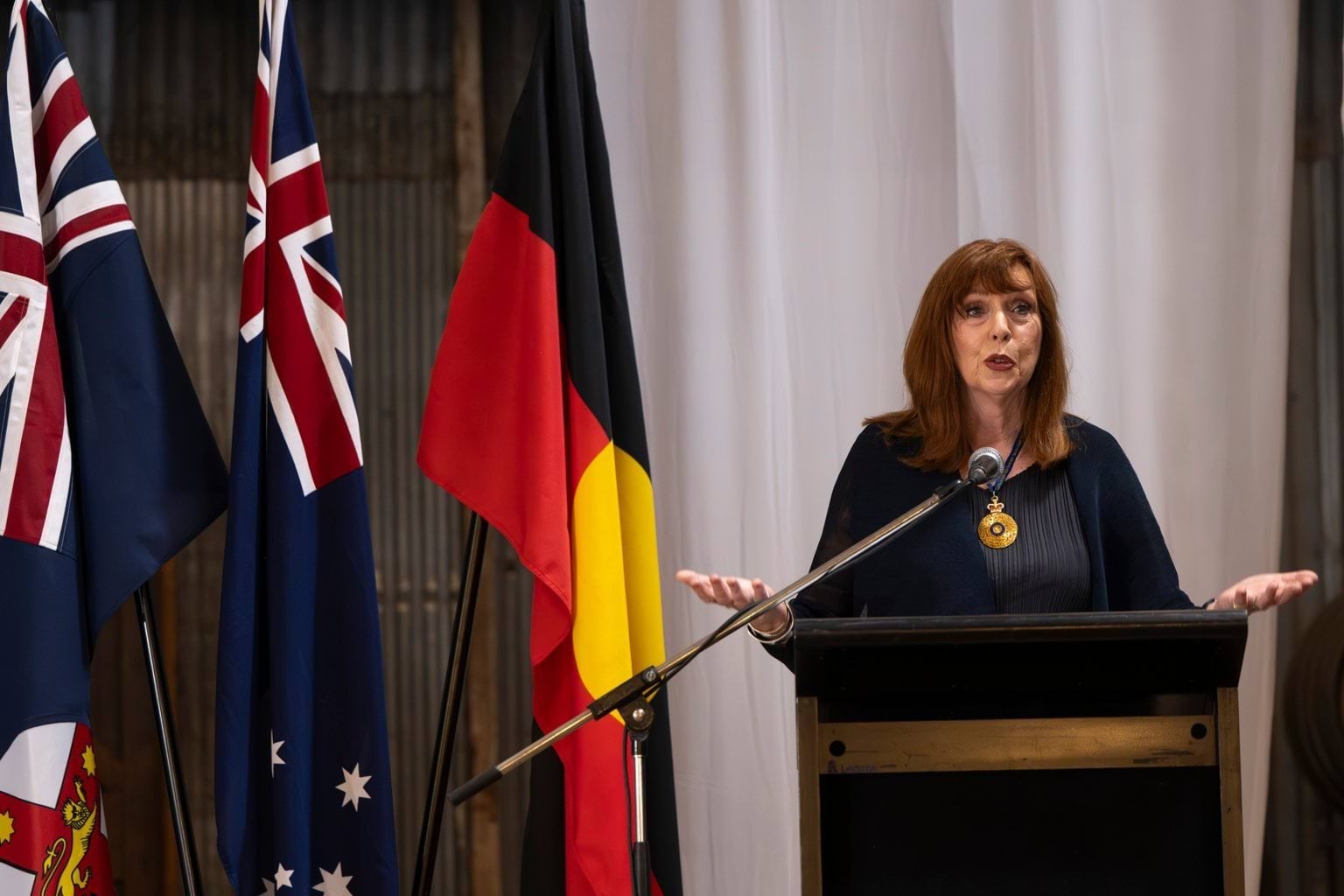
I begin by acknowledging the Traditional Owners of the lands on which this building stands – the Bangerang people – and pay my respects to their Elders, past and present.
And I would like to thank Uncle Dozer for his warm welcome.
This year marks one hundred and seventy-five since the Port Phillip District formally separated from New South Wales, becoming the Colony of Victoria.
We meet here in the ‘birthplace of Federation’ – where, in 1893, some time after Victoria’s Separation, people from our two jurisdictions and beyond came together with an aspiration to create a federated Commonwealth.
We are also here to mark the 50th anniversary of the Australian Honours System that was later established to celebrate the achievements and contributions of citizens of that nation.
And we are here exactly 20 years since the border between our States was formally ratified, bringing to a close the process that identified the border between our two States (then colonies) way back in the mid-1800s.
With that in mind, I’d like to tell you a story about a tree.
This tree – a River Red Gum – is a short walk from Government House Victoria.
It stands on the north-west corner of the Tennyson Lawn of the Royal Botanic Gardens.
Estimates of the age of the tree vary – widely.
It could be as young as 270 years old – meaning it was alive when James Cook joined the Royal Navy.
Or it could be as old as 410 years old – meaning it was a sapling when Dirk Hartog became the second European to set foot on the shores of Western Australia.[1]
Either way, the tree is historic.
It is also a bridge – connecting the Indigenous, colonial and multicultural histories of Victoria.
The tree pre-dates the Botanic Gardens in Melbourne – and stands in an area that was a gathering place for Indigenous Victorians prior to European settlement in 1835.
On November 15, 1851, after news of the official separation from New South Wales reached Victoria, a mile-long procession of Victorians marched over the newly constructed Princes Bridge.
The crowd ended up in the Botanic Gardens, under that large Red River Gum – and after that day, it became known as the Separation Tree.
The tree became a gathering place for colonial Victorians.
It was placed on the Significant Tree Register by the National Trust.
In 2010 and 2013, vandals ringbarked the Separation Tree.
We don’t know what those vandals hoped to achieve by killing the Separation Tree.
But it doesn’t matter.
It doesn’t matter, because seedlings from the original River Red Gum were planted in 1951 and 2001 – and those trees are flourishing.
The Separation Tree is a symbol more than a tree.
The Separation Tree is a connection between our future and our past, a symbol of our Indigenous and colonial heritage as much as our modern multicultural democracy.
And, as such, the Separation Tree cannot die – as long as we hold fast to the principles of connection and democracy that it has come to represent.
Our democracy is like the Separation Tree.
The original generation – the people who met under the tree in 1851 – is no longer alive.
Neither is the generation who debated the merits of a federated Commonwealth here in Corowa in 1893.
And among those who attended were many notable Victorians including the then Premier of Victoria, James Patterson, his opposition Sir Graham Berry, a future Premier of Victoria Alexander Peacock, and Dr Quick from Bendigo who prepared the Corowa Plan.
But just as new Separation Trees took the place of the original – our generation now takes the place of generations past.
All of which begs the question, what democratic legacy will we leave for the generations who follow us?
What will we plant and foster and grow?
The choice – and the responsibility – is ours.
Democracies are about the people who make them work – and the choices they make.
You are here because you have been recognised by our honours system for your choices.
Choices that go to the heart of what we value as a community, as States, and as a nation.
Australia’s future depends on people who choose to make such contributions.
What matters most is how we choose to respond to the challenges we face.
Both of our States have faced trying times in recent months, confronted by the tragedies of natural disasters and acts of unthinkable evil.
In their aftermath, I suggest we turn to each other:
Listen to each other,
Confront hard truths,
And renew the democratic promise of Australia for all Australians.
After all, that is an aspiration that transcends borders.
Thank you.
[1] The first European to land on the coast of what is now Australia was Willem Janszoon in 1606.
Updated