

- Published:
- Thursday 30 April 2026 at 2:59 pm
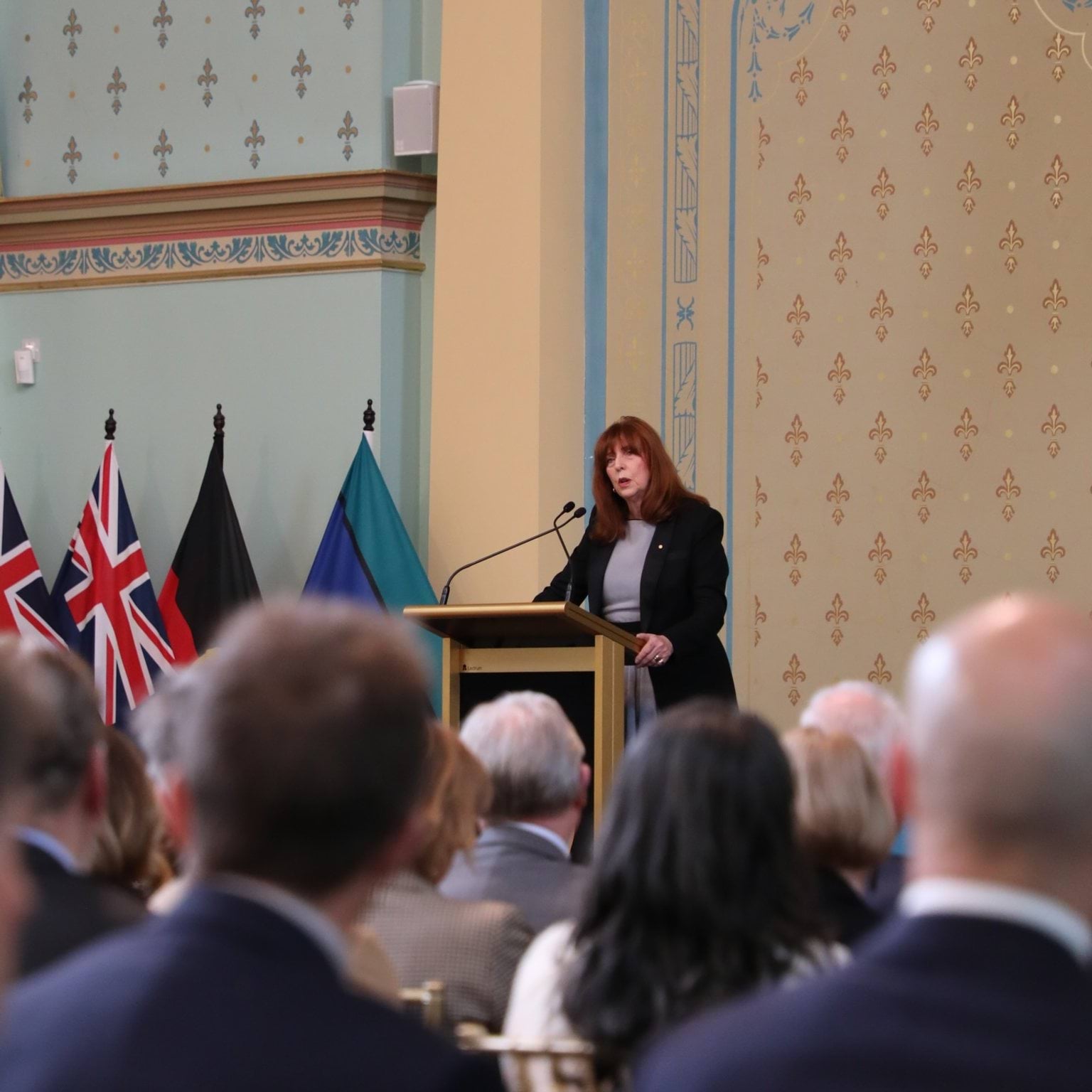
I acknowledge the Traditional Owners of the land on which we are gathered – the Wurundjeri and Bunurong people of the Eastern Kulin Nation – and pay my respects to their Elders, past and present.
I also acknowledge any Elders with us today.
It’s an honour to deliver the Garran Oration – established to honour the life of the Commonwealth’s first public servant, Sir Robert Garran – and, as well, an honour to follow so many distinguished speakers considering matters significant for Australian public life.
And I extend my thanks to the Institute of Public Administration for their invitation to speak.
Introduction
In the popular imagination, an oration named for our nation’s first public servant is unlikely to conjure excitement. Public administration appears a work in prose. Indeed, it is more commonly cast as prosaic – even if people recognise its significance for our society.
And Robert Garran’s contribution to Australia is not well known even by most public servants.
So let me begin then perversely with some poetry that speaks to how we might view his contribution.
In 1891 David Murray[i] wrote:
“Because they live among us, and we know
The unheroic detail of their days,
Since they and we move in familiar ways,
We scant the greatness of the deed they do.
They weld an empire …
…in calm conclave, where each citizen
May speak [their] share of truth with fearless eyes.
This poem was written to praise the path to Australian nationhood. To it, let me add the words of Alfred Deakin in 1898 about Australia’s Constitution, to which Garran contributed (not least through his seminal work with Quick on its interpretation).
“A federal constitution is the last and final product of political intellect and constructive ingenuity…. [a]mong all the federal constitutions in the world you will look in vain for one as broad in its popular base, as liberal in its working principles, as generous in its aim, as this measure”.[ii]
Even without considering the broad contribution of Garran across his professional life, his place in setting the foundations for our nation is seminal.
The assertion that Australia’s democracy is one of the “oldest, most stable and most successful” is one that will not surprise this audience.
Our national democracy draws from 19th century British and American examples. It built from the experience of the colonies of this island nation, crafted by the authors of the Australian constitutional federation, including Garran, and put into practice by public servants, such as Garran.
Is it design or luck that has produced this successful outcome?
And what protects our democracy from instability and crisis?
Democracy and crisis
The rise of populist nationalism, alongside the uncertainties of the “rules-based international order” evident in the conflicts in Ukraine, Gaza, Iran and Lebanon, make us all aware of the prospects and impact of instability and breakdown.
European Union President Ursula von der Leyen, in a speech this year to the Australian Parliament said:
‘The world we live in is brutal, harsh and unforgiving. It feels upside down. What we knew as certainties are in question. The comfort blanket of yesterday is ripped away.’
It is understandable to worry about democracy’s future.
We should be attentive to what is important to maintain a healthy democracy – for we cannot take our stable democracy for granted.
Troubled times show how circumstances can fray expectations and breakdown societal norms – but we should not imagine these times are new.
In 1919, Garran was the senior public servant travelling in Europe with Prime Minister Billy Hughes.
World War One had just ended – leaving 62,000 Australians dead – and the Allies were arguing over the Treaty of Versailles.
Australian soldiers were still fighting – and dying – in Russia against the Bolsheviks.
The Spanish Flu pandemic – the Covid of its day – was killing millions around the world, and thousands across Australia.
Gangs – or pushes – were regularly fighting each other on the streets of inner-city Melbourne.
And, in July 1919, while Garran and Hughes were sailing home from Europe, Australia was hit by civil unrest.
On July 19, some returned servicemen – comrades of the Anzacs who, weeks before, chaired Hughes down Victoria Street in London – ran amok in Melbourne after a Peace Day procession: invading theatres, derailing trams and attempting to capture the Town Hall.
The next day – a Sunday – uniformed soldiers tried to force their way into Victoria Barracks, killing a sentry before fighting a running battle with police in the Domain.
Then, on the Monday, up to 10,000 protestors – mainly returned servicemen – stormed the government buildings at Treasury Place and assaulted Premier Harry Lawson.
Lawson was left with a five-centimetre gash on his head.
But the protestors weren’t finished.
Later that night 6,000 people attacked Russell Street police station – where arrested protestors were being held.[iii]
Police beat them back with a baton charge.
As Gavin Souter wrote in Lion and Kangaroo – his history of Federation – many Australians were worried that this unrest was the forerunner of a communist revolution.
‘The world,’ Souter wrote, ‘was closing in upon Australia.’[iv]
This set of incidents, so distant now, show how quickly the previously unthinkable can happen.
Some years later, Sir John Monash was asked by right wing paramilitary groups to lead an insurrection against the Australian government. His statement that “the only hope for Australia is the ballot box and an educated electorate”[v] was an affirmation of our democracy and a rejection of authoritarianism.
Australian democracy
Australian democracy has been the subject of a recent resurgence in commentary with public acknowledgement of its locally designed features. The distinctive combination of early granting of universal suffrage for white men and then women[vi], the secret ballot from 1856 in Victoria and Tasmania, preferential voting from 1918, and compulsory voting from 1924 are cited as key to our successful, stable democracy, supported by independent Electoral Commissions.
Together this has enabled more than a century in which the overwhelming majority of Australians of voting age have chosen governments through majority preference. And we expect those governments and their leaders to serve and advance the best interests of the nation.
Our federal and State constitutions set out fundamental aspects of our system of government, including the representative democracy which allows the Australian people to select members of Parliament, and the separation of powers between the judicial, executive and legislative branches of government.
State Constitutions are more easily changed than the Commonwealth. They typically contain more detail about how representative democracy will work. In Victoria’s case, for example, the Constitution provides for free elections and the boundaries of electorates to be determined and supervised independent of Ministers.
Together these constitutions outline the way we govern ourselves. They form a bedrock of certainty; that we are a constitutional monarchy, a parliamentary democracy, and a federated nation. While all these features are open to change – change would be difficult – and they have remained true of Australia since Federation in 1901.
This was the bedrock that Robert Garran helped forge.
The way Australia’s constitutions, democracy and federation have worked has changed over the decades, layering strata of laws, regulations and various forms of ‘soft’ or ‘grey’ law on the conceptual bedrock. At times, context and circumstance have tested our understandings and ways of working.
As we consider a more complex and uncertain world, we should understand that bedrock.
Constitutions and Conventions
Constitutions are a guide. They are written, as Polybius said, to counter ‘hubris and arrogance’.[vii]
Drawing from the Westminster tradition, they have not attempted to specify all aspects of our governance. Unwritten rules or conventions govern many aspects of their operation, as constitutional scholar Killey reminds us.[viii]
In particular, much of the shape and function of our governments is not codified in our constitutions. The leaders that represent us, Prime Ministers and Premiers, the Cabinet and its Ministers, and the Oppositions (which are also key to the operation of our parliaments) are not well defined in them.
There is, though, one institution that is clearly included in all these constitutions, the Crown or head of state, the Governors and Governor-General.
Despite the prominence of these roles in our constitutions, they are rarely a matter of public interest or comment.
Yet it is the role and impact of our constitutional monarchy in Australia’s democracy that I wish to consider in more detail.
Australia’s Viceroys
At the apex of our constitutional monarchy, Australia’s Sovereign is King Charles III, “…by the Grace of God King of Australia and His Other Realms and Territories, Head of the Commonwealth”.
The title was established by proclamation on 11 September 2022 on the King’s accession to the throne in the style adopted by Queen Elizabeth II following legislative change in the Commonwealth in 1973.[ix]
The Republic Referendum of 6 November 1999 in Australia was the last time a formal question was put to the Australian people about how their head of state should be selected. The debates had the effect of making clear to the people of Australia (if they were in doubt) that we had a sovereign and were a constitutional monarchy.
Governors and the Governor-General are often described as His Majesty’s representatives in the Commonwealth and the respective States. All are appointed by the monarch on the advice of the relevant Prime Minister or Premier, and any dismissal would follow the same path.
Yet, as Taylor[x] explains, the description of these roles as ‘representatives’ of the Sovereign can be misleading. The Australia Act 1986 precludes the Sovereign from exercising powers in respect of Australia or its States, except in limited and particular circumstances.
The Governors and Governor-General, Taylor suggests, should be understood as a statutory Viceroy or plenipotentiary, rather than a representative[xi]. And if you balk at the colonial overtones of those descriptions, more prosaically, they function as permanent substitutes for the Sovereign, the King of Australia.
Governors and the Governor do not carry out functions that would otherwise normally be carried out by the King, because legislatively the King is not empowered to carry out the constitutional functions conferred on these roles in Australia, unless physically present on Australian soil.[xii] They are not accountable to the King for their actions, nor are they personal representatives of the King[xiii].
From the appointment of the first Australian as Governor-General, Sir Isaac Isaacs in 1931, when the Prime Minister James Scullin strongly insisted in the face of some reluctance from King George V, a new convention in such appointments took hold.[xiv]
Ever since then, Australian governments – rather than Britain – have chosen their Governors and Governors-General.
In 1986, the Australia Act codified that convention.
McGarvie (Victoria’s 24th Governor) argues:
‘The Australia Act 1986 turned the practice regarding the appointment and dismissal of governors into constitutional law … forever beyond the power of the British Ministers to advise the queen on the appointment or dismissal of a governor and beyond their power to direct, control or veto the governor in any way …
‘For practical purposes the Australia Act 1986 may be regarded as completing the detachment of the Australian system of government from the institutions of government located in the United Kingdom, short of Australia becoming a republic.’[xv]
The Role of Governors
The role of Governors and the Governor-General in the respective State and Federal Constitutions, is as Killey[xvi] so succinctly reminds us that constitutionally:
“...all executive powers are vested in the Governor and he or she is required by law or convention to exercise the vast bulk of these powers in accordance with advice. However, by convention, some powers can be exercised without advice, and they are the ‘reserve powers’”.
The advice that the Governor is expected to follow is, in the case of Victoria, written into its Constitution Act 1975. This requires the Governor to receive advice from either the Premier or the Executive Council (s87E) – “Where the Governor is bound by law or established constitutional convention to act in accordance with advice…”.
As Taylor also reminds us, acting on advice, as outlined in Victoria’s Constitution, does not diminish the traditional rights of the Crown – to consult, to encourage or to warn, nor compel them to act on advice “without adequate consideration ... or to act ...to do something illegal”.[xvii]
Acting on the advice of the Executive Council or the Premier is giving effect to the decisions of the government, principally through laws and regulations.
In doing so, the Governor or Governor-General is carrying out the wishes of the people, as expressed through our elected Parliaments.
While it may be obvious that acting on advice is carrying out the wishes of the government, the frame through which the exercise of reserve powers is made is also vitally important.
The reserve powers are the only powers that are exercised without, or contrary to, advice from ministers.
The reserve powers are generally held to be the appointment of and dismissal of the First Minister, and refusal of a request for dissolution of the Parliament.
In Killey’s work on Australian constitutional conventions, the foreword was written by Charles Curwen, legendary Official Secretary to the Governor of Victoria – a man who served ten Governors of Victoria for more than forty years.
His foreword notes that
‘The principal duty of an Australian Governor is to be the guardian of the Constitution on behalf of the people of the State he or she serves. It has often reminded me of the equivalent of a modern-day commercial pilot of an aircraft with hours of repetitive work and great responsibility mixed together with the very occasional seconds of sheer terror. The role of the Governor is very similar; on the rare instances when he or she has to act in the lonely position of executing their duty under the reserve powers, they must turn to constitutional convention and practice.’[xviii]
The crisis moments may be few and, unless you are interested in constitutional crises, not well-known – although most Australians know of the 1975 Dismissal of the Whitlam Government by Governor-General, Sir John Kerr.
However, there are other less dramatic moments when the exercise of vice-regal powers is an important part of ensuring that our representative democracy works in ways that respect the wishes of its citizens.
Recently, Tasmania’s Governor, Barbara Baker, gave us an example of the exercise of reserve powers that facilitated stable democracy.
On 5 June 2025, the Legislative Assembly in Tasmania passed a no-confidence motion against the Rockliff Government. The Assembly at that time was without a clear party majority.
Premier Jeremy Rockliff advised the Governor to dissolve the Legislative Assembly and call an early election – only 15 months into the Parliamentary term.
The Governor did not immediately grant the Premier’s request.
Instead, she exercised her reserve powers – taking time to talk to the State Opposition and see if an alternative Government could be formed.
By 11 June, the Governor was satisfied no alternative Government could be formed. She dissolved Parliament, issuing a writ for an election for 19 July.
The vote returned a hung parliament of very similar composition to the previous parliament.
The Governor reappointed Rockliff under the incumbency convention until he could test the confidence of the House.
A fresh no-confidence motion failed, with Rockliff confirmed as Premier.
As Richard McGarvie commented in his book, Democracy:
‘The basic constitutional convention… binds the head of state to act only and always as advised by the Minister. However, the convention has an exception, which allows a personal discretion to act independently of ministerial advice when it is absolutely necessary to do so for the preservation of representative democracy.’[xix]
Reserve powers are the safeguards of representative democracy. And their exercise is in the hands of our Governors and Governor-General.
The Governor or Governor-General as a guardian of the Constitution is a vital part of our democracy, even if this role is rarely visible.
As indicated above, the common exercise of Governor or Governor-General powers is on advice through the Executive Council or directly by the Premier.
The frequency and composition of Executive Councils vary a little across States and Commonwealth, so let me confine myself to the Victorian example. In Victoria, Executive Council, composed of four Ministers (with a quorum of two) and chaired by the Governor, together known as Governor-in-Council, meets on Tuesdays for 46 to 47 weeks across the year.
Decisions made by Cabinet or individual Ministers in relation to a variety of matters from appointments, changes to regulations, and many other administrative and government decisions come to Executive Council.
The three rights to consult, encourage and warn government are, of course, the rights of the Crown outlined by Bagehot in his work on The English Constitution. Bagehot[xx] opined ‘…a king of great sense and sagacity would want no others …’.
While in the midst of crisis we observe the exercise of reserve powers, the more common convention of questioning advice given is not open to observation. However, the ability to do so engenders a check on whether decisions are properly formed. This questioning is not the Governor’s opinion about the decisions being made or policy enacted, but to ascertain that a decision conforms to the appropriate laws and processes.
It is in this sense that McCaughey, the 23rd Governor of Victoria, wrote that acting in the interests of the people “The Crown has no power itself except the power to prevent others having absolute power...”.[xxi]
The constitutional role of the Governor or Governor-General is complemented by ceremonial and community roles. The details vary between States and Commonwealth, but ceremonially the Governor or Governor-General is a symbol of the state, whether presiding over awards and honours, commemorating key moments and achievements in our civic life, welcoming international dignitaries or visiting internationally on behalf of the state.
The community role involves engaging with citizens across the state, welcoming them to events, learning about their organisations, their work and their lives. Typically, this means travel to various regions and visiting many organisations, economic, social and cultural. It also means responding to the emergencies and crises that arise, whether fire, flood or violence, with empathy and sympathy.
These ceremonial and community roles complement the constitutional role. They are significant ballast, providing symbolic and tangible demonstration of the non-partisan nature of the Governorship – its separation from the divisions of competing electoral programs.
In all these roles, the Governor or Governor-General is representing the state, an entity that is distinct from the government of the day. The role must be exercised without reference to partisan or personal views, and for that reason and by convention the Governor does not vote in elections.
The Governor or Governor-General does not have a policy program since decisions made give effect to the policies and program decisions of the elected government.
They may seek to learn more about regions, organisations and people of the state (and over time they have embraced a wider scope of organisations and people). However, this is not equivalent to the policy program of elected governments.
The Governor or Governor-General when speaking attempts to speak for and with the people of the State or nation. Ceremonies, such as those for Australia Day or Anzac Day, require finding common ground – even when the ground appears to be fracturing. In this sense the expectation of a Governor or Governor-General is to strengthen or, at least, not to weaken the social fabric of our community.
These distinctions are the essence of a constitutional monarchy.
Understanding the bedrock: our beginnings
Let me return to the questions at the beginning of this oration. Where might we put the weight between design and luck in the construction of our successful, stable democracy? And what are our protections against instability or crisis that ruptures its continuation?
The everyman ethos of our democracy, a form of egalitarianism, was baked into colonial Australia when, as the great Australian historian John Hirst explained, …
‘In 1850 the House of Lords was tricked into halving the qualifications for the franchise in Australia. It was told that under the existing rules rich ex-convicts got the vote and free working men recently arrived did not. A respectable electorate required a low qualification.’[xxii]
As population boomed, as Hirst puts it, ‘the tenant of any hovel … got the vote’.[xxiii]
By 1858, universal male suffrage was granted to white men in most Australian colonies – including Victoria – and the vote was first extended to white women in 1895.
Almost from its beginnings, then, Australian democracy was shaped by the collective voting power of working people.
Australia’s voting rights were originally discriminatory – excluding Indigenous Australians, Pacific Islanders, Indians, Chinese and Japanese – but, since the end of the White Australia policy, their egalitarian ethos has been expanded to include all Australians.
Australia’s democracy did not develop like many other great democracies.
It arrived suddenly, as it did in France and the US, but not through a revolution. It did not evolve over a century, like the UK.
The Eureka Stockade is an important moment in the development of Australian democracy – it led to the fast-tracking of democracy in Victoria and the invention of the secret ballot – …
... but fifteen minutes of mayhem in Ballarat are not the same as George Washington crossing the Delaware or the storming of the Bastille.
If anything, the most important part of Eureka was the trials – when a jury of white men refused to convict John Joseph, an African-American miner, of treason.
Before I move on, a hard truth needs to be acknowledged.
Australia’s transition to democracy was peaceful, but it followed – and coincided with – the dispossession and deaths of Aboriginal and Torres Strait Islanders.
And Indigenous Australians were excluded from Australian democracy well into the 20th century.
Australia’s transition to democracy was peaceful, but European settlement came with violence, too.
Those two realities are not mutually exclusive.
Both should be acknowledged.
The other feature of 19th century Australia, as Judith Brett argues, was:
“By the time the Australian colonies were establishing their political institutions … the British had well and truly defeated their autocratic monarchs. Britain was a constitutional monarchy, with legislative and executive power firmly in the hands of the parliament and the monarch reduced to a largely ceremonial role.”[xxiv]
Practical, pragmatic democratic traits, such as compulsory voting, are expressions of – rather than foundations of – Australia’s democratic ethos.
Our representative democracy was achieved early in our colonial history, attached to and bolstered by a constitutional monarchy and rested from its inception on widespread participation of our citizenry (noting the early exclusions).
There is luck in the timing, but pragmatic and robust design in our law and practice prevailed over philosophy and rhetoric.
Garran writes ‘The law is the sublimation of common sense.’[xxv] And furthermore that:
‘The Constitution must be able to develop to meet the changing needs of the community, otherwise it will cramp the growth of the community till breaking-point is reached.’[xxvi]
While our Federal Constitution has resisted the change its founders hoped to provide through referenda, it has the advantage of conventions whose flexibility fills some of these gaps, and the State Constitutions have more ability to change to meet the circumstances of the times.
Understanding our bedrock: our protections
This discussion of the interaction of representative democracy and constitutional monarchy in Australia, has been through examining the role of Governors and Governors-General.
I am interested in the pragmatic question of what our experience of constitutional monarchy means for representative democracy.
The role of our Governors and Governor-General acts as a series of checks to preserve a functioning representative democracy. It ensures the elected government of the day, formed in the lower House of parliament, represents the democratic will of the people – and no other.
Federation means there can be countervailing expressions of the will of the people within our nation, but Governors and Governors-General do not represent a separate programmatic mandate from the people. They ensure that the government of the day is able to legally and effectively make decisions.
Conclusion
Australia has built a democratic system that has weathered crises, relying on its distinctive processes at the ballot box to put in place governments that represent the majority preference of its citizens.
Our peculiarly Australian combination, including building a ‘national’ system from a federation, has had more attention in recent times and engendered some national pride. Yet we do not specifically celebrate this achievement (unless you count the ‘democracy sausage’).
It came without the ‘guns and glory’ of revolution. It came unaccompanied by the rhetoric and philosophy that would form a national statement of values.
We see that system at play each Saturday an election is held. Our Premiers and Prime Ministers speak of the direction and values of our nation.
The largely invisible operations of the constitutional monarchy in Australia buttress this system.
We rarely see the interventions of Governors or the Governor-General and then only in a crisis. The ceremonial and community roles of Governors are there to demonstrate their non-partisan and impersonal role in supporting the social fabric.
It is important that the checks and balances, the protections, powers and conventions, operate when needed, rarely seen, and without fanfare.
This means that our governments have primacy in how our nation and our States express the aspirations of our people. And the decisions about what those aspirations should be, come regularly and dependably to our citizens for their deliberation.
This is a quiet success we should celebrate.
Thank you.
[i] David Christie Murray, Contemporary Review, 60, July-December 1891, London.
[ii] Judith Brett, The Enigmatic Mr Deakin, Text Publishing, Melbourne, 2017 p 269.
[iii] Gavin Souter, Lion & Kangaroo, William Collins, 1976, pp. 296-297.
[iv] Souter, p. 298.
[v] Geoffrey Serle, John Monash A Biography, Melbourne University Press, 2008, p. 515.
[vi] White men in all states by 1900 – in South Australia 1856, in Victoria in 1857, and in New South Wales in 1858; and white women in 1895 (South Australia) and federally in 1902.
[vii] John Keane, The Life and Death of Democracy, Simon & Schuster, 2009. Page 79.
[viii] Ian Killey, Constitutional Conventions in Australia, Australian Scholarly Publishing, 2009.
[ix] Greg Taylor, The Constitution of Victoria, The Federation Press, Sydney, 2006, p.72.
[x] Taylor, pps 64-65, 74-75.
[xi] Taylor, p. 65.
[xii] The King would still exercise powers on the advice of the relevant elected Australian government when on Australian soil. The King could not unilaterally dismiss an Australian Prime Minister since that power is not constitutionally available to them – only to the Governor-General.
[xiii] Taylor, pps 74-75.
[xiv] McGarvie. Page 27.
[xv] McGarvie. Page 25.
[xvi] Killey, p.130.
[xvii] Taylor, p. 119.
[xviii] Killey. Page viii.
[xix] Richard E. McGarvie, Democracy, Melbourne University Press, 1999. Page 122.
[xx] Walter Bagehot, The English Constitution [1889], The Legal Classics Library, NY, 1995, p.112.
[xxi] Davis McCaughey, Tradition and Dissent, Melbourne University Press, 1997, p.182.
[xxii] John Hirst, Selected Writings, La Trobe University Press, 2025. Page 301.
[xxiii] Ibid.
[xxiv] Judith Brett, From Secret Ballot to Democracy Sausage, Text Publishing, Melbourne, 2019, p.5.
[xxv] Garran, Page ix.
[xxvi] Garran. Page 167.
Updated